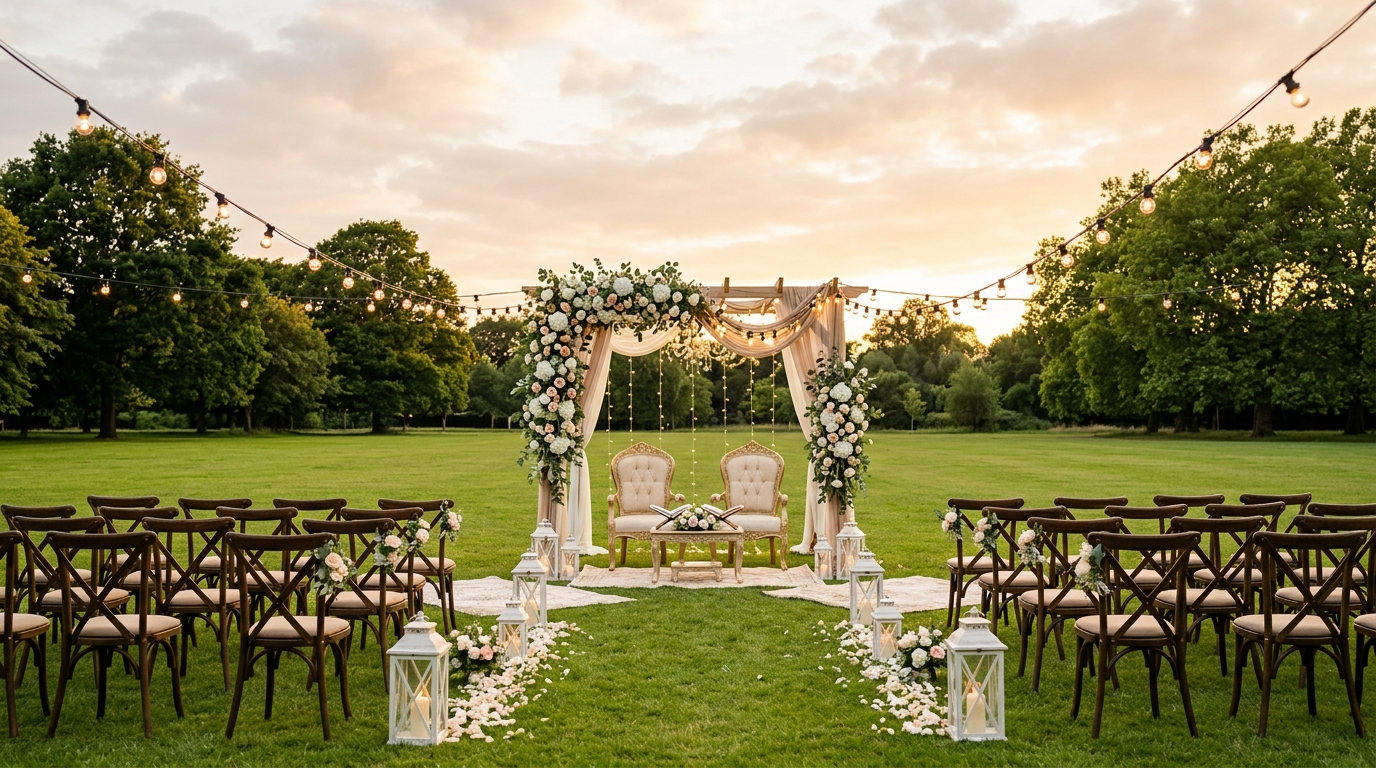
What is the difference between a Nikah and a Walima? The Nikah is the Islamic marriage ceremony itself, the moment the marriage contract is agreed and the couple are married. The Walima is the celebration feast that follows, traditionally hosted by the groom’s family to announce and share the marriage. One is the vows; the other is the party.
If you are planning a Muslim wedding, this is the first thing the wider family will ask about: are we doing them on the same day, on different days, in the same place? Here is a clear, friendly explainer of each, how families usually arrange them, and how you can hold both on one open-air field in Ilford without paying for two venues.
At a glance
- Nikah = the ceremony and marriage contract. Often smaller, more solemn, the religious heart of the day.
- Walima = the celebration feast after the Nikah, traditionally the groom’s family’s event, usually larger.
- Families do them same day or separate days; there is no single right way.
- At The Outfields you can host both on one field for up to 500 guests, with your own halal caterer.
The Nikah: the marriage itself
The Nikah is the ceremony where the marriage actually happens. It centres on the marriage contract, the consent of both parties, the mahr (the gift from groom to bride), and witnesses. An imam or officiant usually leads it, and there are readings and duas. It can be intimate, just close family, or larger, but in spirit it is the solemn, sacred part of the wedding.
It does not need to take place in a mosque. A Nikah can be held at home, in a hall, or outdoors. At The Outfields it happens in the open air, with the seating, stage and ceremony area arranged to suit your family.
The Walima: the celebration feast
The Walima is the wedding banquet that follows the Nikah. By tradition it is hosted by the groom’s family as a way of publicly announcing and celebrating the marriage, and of feeding the community. This is usually the bigger, more lavish event: the long tables, the food everyone remembers, the décor, the celebration that runs into the evening.
The Nikah is where two people are married. The Walima is where everyone celebrates that they are.
Nikah vs Walima, side by side
How they differ in practice
- Purpose: the Nikah marries the couple; the Walima celebrates and announces the marriage.
- Host: the Nikah is often arranged by both families; the Walima is traditionally the groom’s family’s event.
- Size and mood: the Nikah can be smaller and more solemn; the Walima is usually larger and more festive.
- Timing: the Walima comes after the Nikah, whether minutes later on the same day or days afterwards.
- Food: the Walima centres on the feast; the Nikah may have light refreshments or none.
Same day or separate days?
There is no single rule, and customs vary by family and culture. Some hold the Nikah quietly in the morning or the week before, then the Walima as the main celebration. Many do both in one day: the Nikah in the afternoon, the Walima as the lights come on. Mixed and fusion families sometimes fold a civil ceremony in too. Whatever your family does, the layout of the day is yours to set.
A planning tip: decide early whether the Nikah and Walima share a day, because it shapes everything: guest counts, the running order, catering volumes, and how long you need the space. A dry-hire venue gives you the flexibility to choose either way without being locked into a hall’s fixed turnaround.
Hosting both at one outdoor venue near Ilford
Because The Outfields is a dry-hire field that is yours for the hire, you are not juggling two venues or rushing guests across town. You can hold the Nikah at golden hour where the light is best, then turn the same field into the Walima as the festoon lights come on.
- Your halal caterer for the Walima feast, not a fixed hall menu.
- Your layout for both: a ceremony area for the Nikah, separate seating if your tradition needs it, long tables for the feast, room for the baraat.
- An on-site coordinator to map the running order so each part of the day gets its moment.
Planning a Nikah, a Walima, or both?
Tell us your date and a rough guest count and we will reply within 24 hours with availability. We will help you map the day on one field, whichever way your family does it.
Frequently asked questions
What is the difference between a Nikah and a Walima?
The Nikah is the Islamic marriage ceremony and contract, the point at which the couple are married. The Walima is the celebration feast that follows, traditionally hosted by the groom’s family to announce and share the marriage.
Which comes first, the Nikah or the Walima?
The Nikah always comes first because it is the marriage itself. The Walima follows, either later the same day or on a separate day, as the celebration of that marriage.
Can the Nikah and Walima be on the same day?
Yes. Many families hold the Nikah in the afternoon and the Walima in the evening on the same day. Others separate them by days. Both are common, and the choice is yours.
Can you hold both a Nikah and a Walima at one venue?
Yes. At The Outfields the field is yours for the hire, so you can hold the Nikah and the Walima on the same open-air site for up to 500 guests, with your own halal caterer.
Who traditionally hosts the Walima?
The Walima is traditionally hosted by the groom’s family as a way of publicly announcing and celebrating the marriage, though customs vary between families and cultures.
The Outfields, an open-air event venue at Valentines Park, Ilford. Weddings, Nikah & Walima, Eid and cultural celebrations under the open sky.