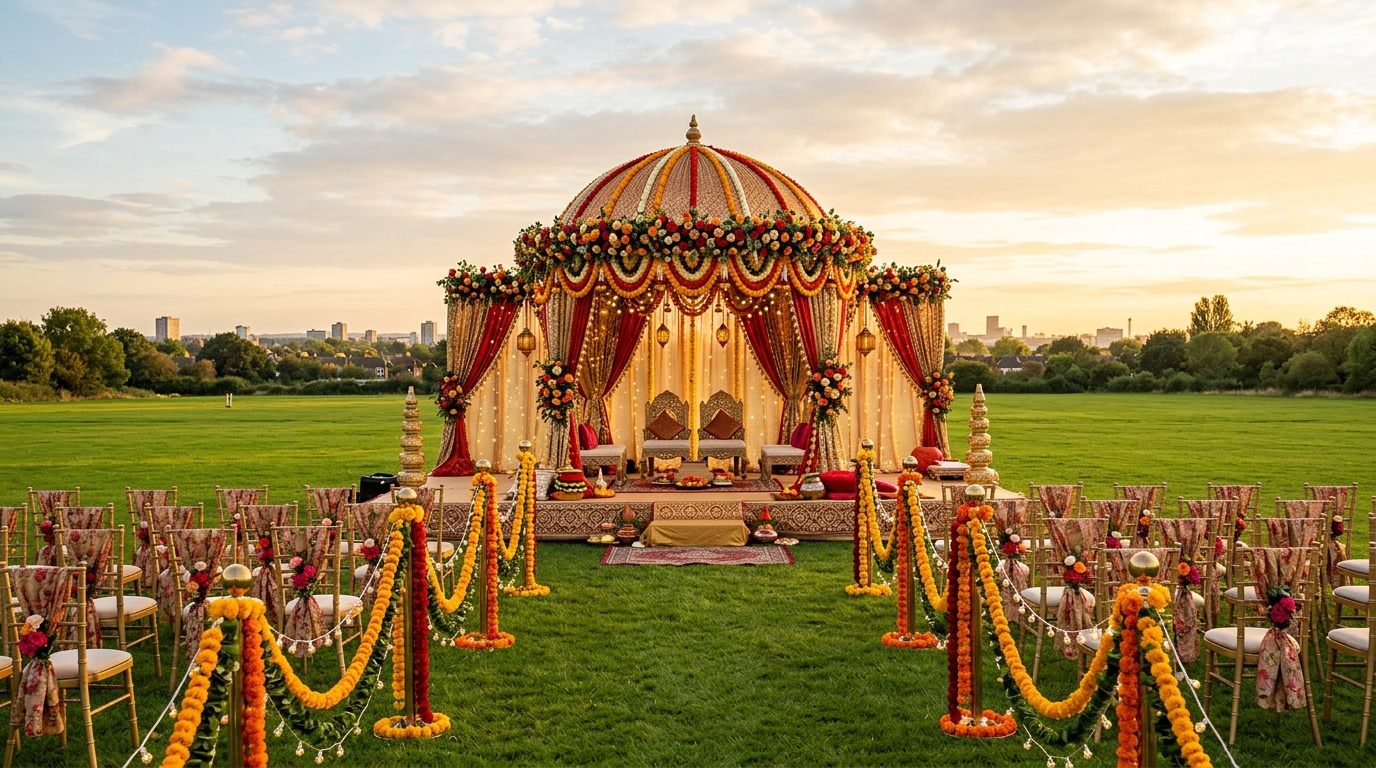
Can you have a traditional South-Asian wedding outdoors? Yes, and a blank field handles your traditions better than a fixed hall does. The baraat needs room to arrive, the stage needs a focal point, the seating may need to be arranged for men and women separately, and the sound needs planning. An open field gives you space for every one of those, because nothing about the layout has been decided for you. At The Outfields, an open-air space for up to 500 guests at Valentines Park, Ilford, the field becomes whatever your family’s tradition needs.
The worry we hear most often is not the weather. It is “can an open field really hold our wedding?” The honest answer is that the things that make a South-Asian wedding feel right, the entrance, the stage, the seating, the scale, are exactly the things a hall struggles with and a field does not. Here is how each tradition works outdoors.
At a glance
- The baraat gets a proper entrance, with room to arrive instead of squeezing through a hall doorway.
- The stage sits where the light is best, with seating arranged around it however you wish.
- Separate seating for men and women is simple to zone on an open layout.
- Up to 500 guests outdoors, with your own halal caterer and your own décor through dry hire.
The baraat: room for a proper arrival
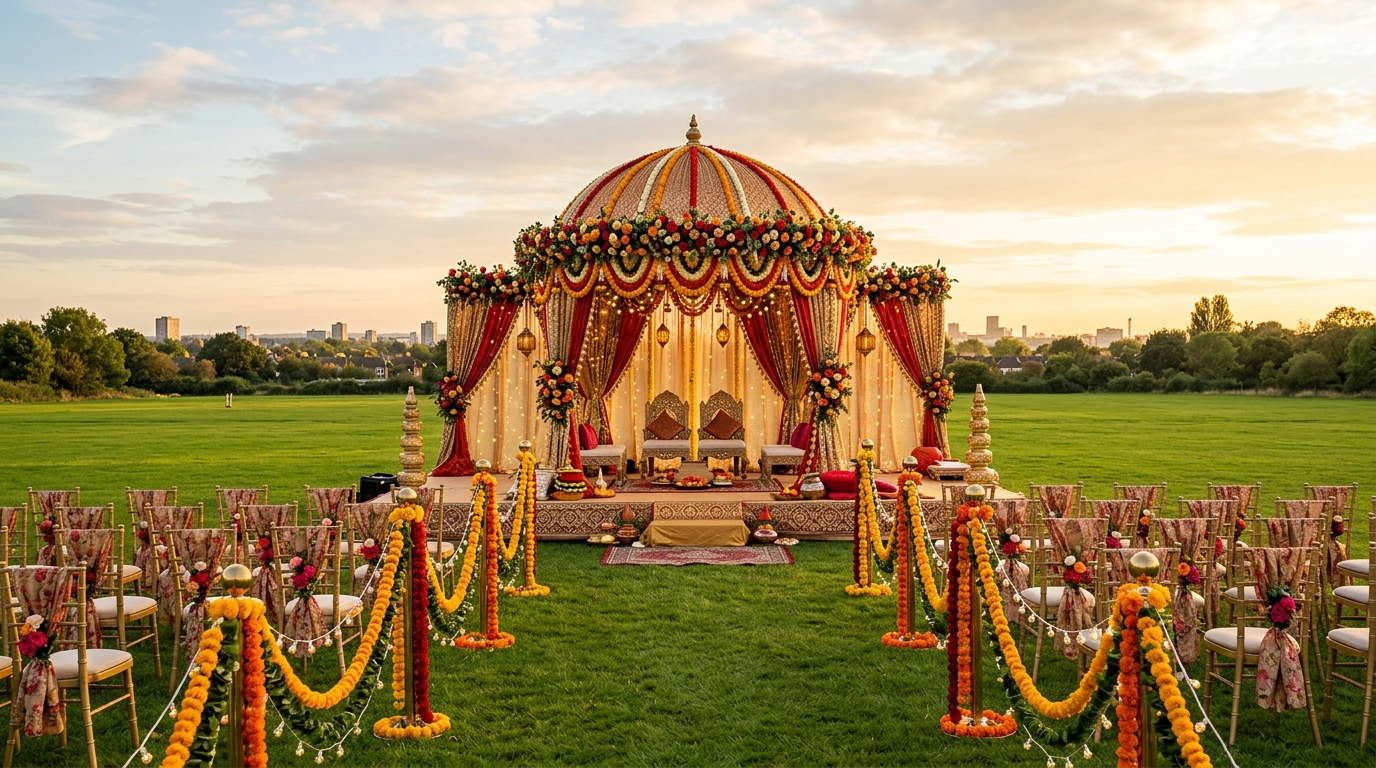
The groom’s procession is meant to be seen. Drums, dancing, the slow joyful walk towards the bride’s family. In a banqueting hall, all of that energy hits a set of double doors and a corridor. On an open field, the baraat has a real entrance: a garland-lined pathway, space to dance, and the whole celebration in view as it arrives. The procession finally gets the scale it was always meant to have.
A baraat is a grand entrance. Give it a field and it stops being a queue at a doorway.
The stage, the mandap, the focal point
Wherever the couple sits, that spot anchors the whole day, and outdoors you choose exactly where it goes. Set the stage where the golden-hour light falls, with the open sky behind it for the photographs. There are no pillars to work around, no low ceiling pressing down on the décor, no fixed top-table position dictating the room.
What the open layout lets you build
- A stage that fits your tradition. An ornate seating area, a mandap, a draped backdrop, however your family marks the couple’s place, designed by your own stylist with full height and space to work.
- Seating arranged your way. Long banquet tables for a shared feast, rounds for a relaxed flow, or rows facing the stage. The grass takes the shape you give it.
- A natural flow between moments. The ceremony, the meal and the celebration can each have their own zone on the same field, rather than one room being reset between them.
Segregated seating, handled simply
For families who observe separate seating for men and women, a fixed hall often forces an awkward compromise: a curtain across a room that was never designed for it. An open field makes the same arrangement effortless. You zone the space with draping, marquees or distinct seating areas through our suppliers, so each group has its own comfortable, properly considered space rather than a partition wedged into someone else’s floor plan. Your coordinator helps map it so it feels intentional, not improvised.
On the sound: open-air audio is the one detail worth planning early. The ceremony, the speeches and the music each need to carry across a large field, so brief your AV supplier on the running order from the start. Done right, the duas and the speeches reach everyone, and the music fills the night without bouncing off four walls. Your coordinator builds the amplification plan into the layout.
The catering freedom that changes everything
For most South-Asian families, the food is not a detail of the wedding; it is half the wedding. The biryani, the grilled meats, the sweets, the sheer abundance of it, all of that carries memory and meaning, and it is the part a fixed hall menu most often gets wrong. This is where dry hire quietly does its best work.
Because The Outfields is dry hire, the caterer is yours to choose. Bring the halal caterer your family trusts, the one whose food the aunties actually approve of, and set the menu, the quantities and the service style yourself. There is no in-house kitchen to negotiate with, no awkward conversation about whether the meat is halal, no package that assumes a Western three-course meal when your day calls for live stations and a feast that runs for hours. You serve the food your celebration is built around, exactly as your family keeps it.
At a South-Asian wedding, the food is not a line on the budget. It is a love language. Dry hire hands it back to you.
Nikah, Mehndi, Walima: one field, many days
A South-Asian wedding is rarely a single event, and the open field flexes to hold the whole arc of celebration rather than just one afternoon of it.
The celebrations the field can carry
- The Mehndi. Colour, music and dancing under festoon lights and an open sky, the kind of vibrant, decor-heavy night that feels cramped in a function room and comes alive on a field.
- The Nikah. The ceremony itself, in a quiet, considered space, with seating arranged for your family’s traditions and room for the moment to breathe.
- The Walima. The groom’s feast, the large-guest celebration where the 500 capacity and the long banquet tables come into their own.
- The whole day blended. Many couples run the ceremony and the celebration on one site, zoned across the same field, so guests never decamp between venues.
Whether you hold one of these here or several, the field shapes itself to each. That is the advantage a fixed room can never offer: it does not impose a single use, it takes the one you bring.
The scale your guest list needs
South-Asian weddings are big by nature, and the local halls often cannot hold the guest list a family actually has. The Outfields takes up to 500 guests outdoors, with an indoor space for 70 alongside, and an 8-minute walk from Ilford station on the Elizabeth line for the relatives travelling in. Because it is dry hire, you bring your own halal caterer, your own décor and your own traditions, and arrange the day exactly as your family keeps it.
Answering the worry that really stops families
Strip away the individual questions, baraat, stage, seating, sound, and what families are really asking is one thing: will an open field feel less proper, less grand, less like a real wedding than a hall? The honest answer, from the celebrations that happen on open ground, is the opposite. Scale is grandeur. A guest list of hundreds under festoon lights and an open sky feels more impressive, not less, than the same guests packed into a room built for fewer.
The halls became the default in Ilford and Redbridge for practical reasons, not because they are the finest setting for a South-Asian wedding. They hold a crowd indoors, and for years there was little else. An open field changes the choice. It offers the same capacity and more, with light, air and a backdrop no banqueting suite can match, and it hands the traditions back to the family instead of fitting them into a fixed room.
None of this asks you to give anything up. The baraat still arrives, the stage still glows, the seating still honours your customs, the food is still yours. The only thing that changes is the ceiling: there isn’t one. For a celebration this important, that turns out to be a gift, not a gamble.
If you are planning the ceremony as well as the celebration, our guides to the outdoor Nikah venue and the difference between Nikah and Walima cover how families usually split the days, and the best Asian wedding venues in Ilford sets the open field against the local halls.
Tell us about your wedding
Baraat, stage, separate seating, a guest list in the hundreds: tell us how your family keeps the day and we’ll map a layout for it. Send your date and a rough guest count and we’ll reply within 24 hours.
Frequently asked questions
Can you have a traditional South-Asian wedding outdoors?
Yes. An open field holds the baraat entrance, the stage or mandap, separate seating and a large guest list more easily than a fixed hall, because the layout is yours to set. At The Outfields you can plan for up to 500 guests outdoors with your own caterer and décor.
Is there room for the baraat to arrive?
Yes. An open field gives the groom’s procession a proper entrance, with a garland-lined pathway and space to dance, rather than squeezing through a hall doorway.
Can the venue do separate seating for men and women?
Because it’s an open field with a flexible layout, you can zone the space into separate areas for men and women using draping, marquees or distinct seating through our suppliers. Your coordinator helps plan it.
Can I set up a stage or mandap outdoors?
Yes. You and your stylist place the stage or mandap where the light is best, with full height and space and no pillars or low ceiling to work around. The open sky sits behind it for the photographs.
How do you handle sound at an outdoor wedding?
Open-air audio is planned with your AV supplier and coordinator from the start, so the ceremony, speeches and music all carry across the field. Brief them on the running order early so each moment is covered.
The Outfields, an open-air event venue at Valentines Park, Ilford. Weddings, Nikah & Walima, Eid and cultural celebrations under the open sky.