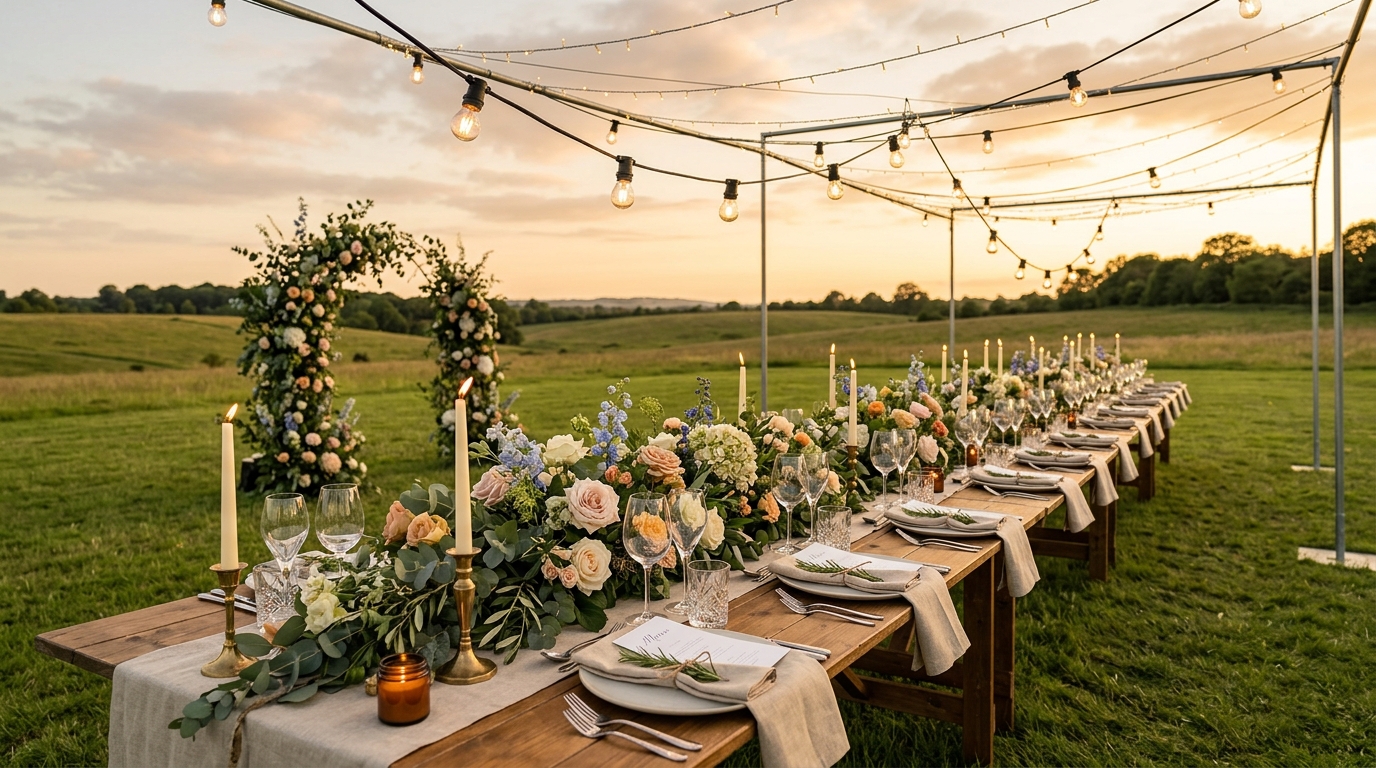
What suppliers do you need for a dry-hire venue? At a minimum: a caterer, a furniture and equipment supplier, a florist or stylist, and lighting. Add AV or a DJ for sound, and a marquee if you want a covered option. Dry hire means you bring these in yourself, which sounds like more work and is really just more control. At The Outfields you can use our approved supplier network or bring your own trusted teams.
The word “dry hire” puts some couples off because it sounds like you are handed an empty field and left to it. You are not. You are handed an empty field and a coordinator, a supplier network and a clear list of who to book. Here is exactly which suppliers a dry-hire wedding needs, what each one does, and the order to book them in.
At a glance
- The core team: caterer, furniture and equipment hire, florist or stylist, lighting, and sound or AV.
- Dry hire = your choice of supplier, including your own halal caterer, not a fixed in-house list.
- The Outfields keeps an approved supplier network, or you bring your own trusted teams.
- Book the people before the props: caterers and florists go first, small details later.
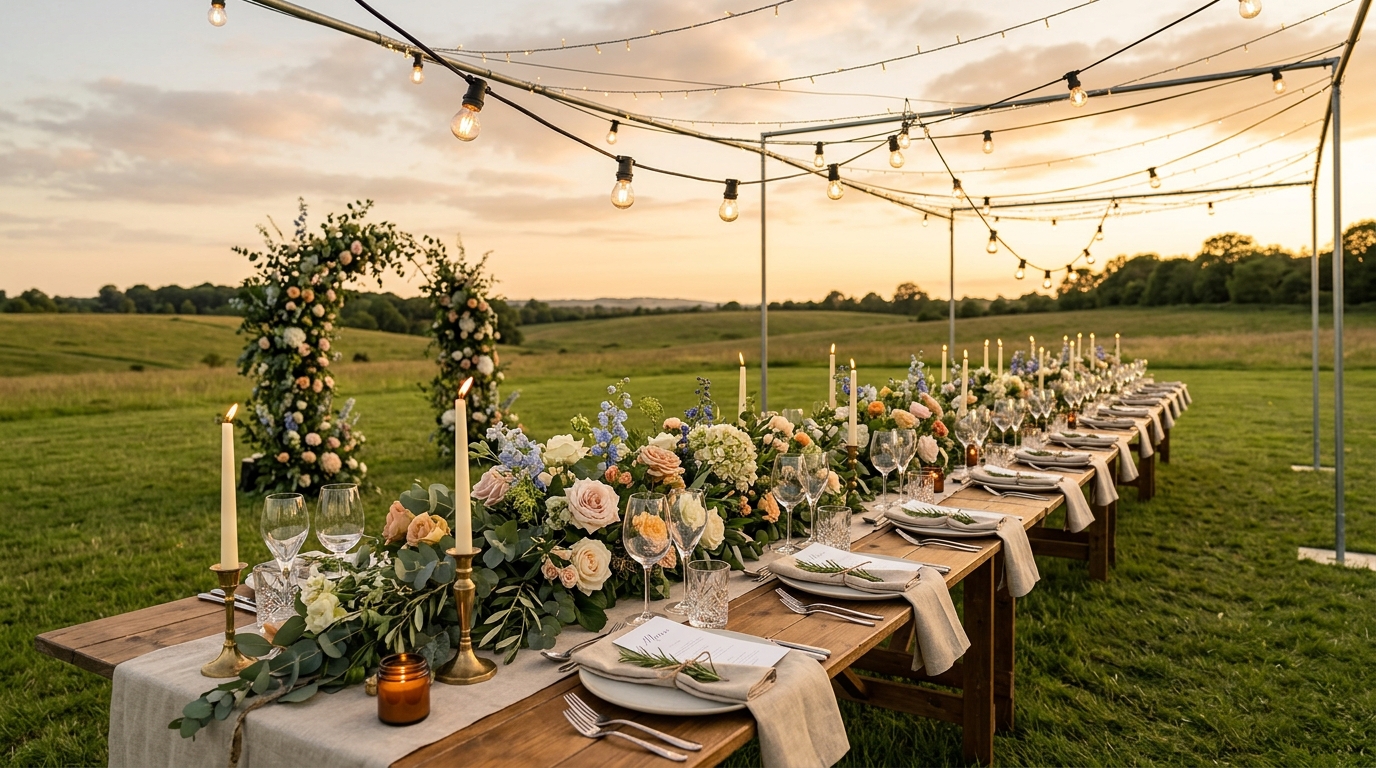
The suppliers a dry-hire venue actually needs
Strip it back and the list is shorter than wedding forums make it feel. Most dry-hire days are built from a handful of key suppliers, plus a few extras depending on your vision.
Your dry-hire supplier checklist
- Caterer. The big one. On a dry-hire field you pick your own, including a halal caterer if that is what your family needs, with the menu and service style you want rather than a hall package. They often also handle crockery, cutlery, glassware and waiting staff, so ask.
- Furniture and equipment hire. Tables, chairs, linen, a bar, sometimes a generator and power distribution for an open-field site. This is the backbone of the layout.
- Florist and stylist. Centrepieces, the ceremony arch or stage, aisle dressing, and the overall look. On a blank field, this is where your colours and theme come alive.
- Lighting. Festoon and fairy lights are the signature of an outdoor evening, and they double as practical light once the sun drops. Worth treating as its own supplier for a big space.
- Sound and AV. A DJ or band, plus a microphone and speakers for speeches, the ceremony and any cultural elements. Open-air sound needs planning, so brief this early.
- The optional but useful. A marquee for cover, a photographer and videographer, a cake supplier, and any cultural specialists such as a stage and mandap designer. Add as your day calls for them.
Dry hire is not “you do everything.” It is “you choose everyone.” Those are very different things.
The order to book them
The trick is sequence. Book the suppliers who are hardest to replace first, and leave the easily swapped details until you have headspace.
- First: the caterer. They get reserved earliest for peak dates, and your guest count and budget partly hang off them.
- Next: furniture, lighting and the florist or stylist, because together they define the layout and the look the rest of the day works around.
- Then: sound and AV, the photographer, and any cultural specialists, briefed with your running order so they plan around the real schedule.
- Last: the small, swappable details, signage, favours, table plans, the things that are easy to change late without anyone noticing.
Why an approved network helps: a supplier who has worked the field before knows the access, the power, the ground and the timings. That is one less brief to write and one less unknown on the day. Use ours where it suits, bring your own where you have a team you trust, and let your coordinator make the two work together.
How to brief a supplier for an open field
An open-field event asks suppliers a few questions a hall never does, and the couples who have the smoothest days are the ones who raise them at the booking stage rather than the week before. None of it is difficult; it is just worth saying out loud.
The questions worth asking up front
- Have you worked an outdoor or dry-hire site before? Experience on grass, away from a fitted kitchen and mains sockets, matters more than experience in a familiar hall.
- What do you need from the site? Power, water, vehicle access, set-up and pack-down time. Get this in writing so nothing surprises anyone on the day.
- What is your wet-weather position? A good supplier has a plan for rain, and dovetails it with your marquee or covered backup.
- Who coordinates with whom? Confirm that your suppliers are happy to take a shared running order and work alongside the venue’s coordinator.
Share one running order and one site plan with every supplier, and the day assembles itself. The caterer knows when the florist needs the tables clear; the lighting team knows when the band loads in; the photographer knows when the light will be best. That single shared document is the quiet secret of a calm dry-hire wedding.
Mixing your own suppliers with the network
You do not have to choose between “all your own” and “all the venue’s.” Most couples land somewhere in between, and that is exactly the point of dry hire. Keep the suppliers that carry real meaning for your family, the caterer who has cooked at every wedding you can remember, the florist a cousin recommended, and lean on the approved network for the rest, where a team that knows the field saves you a brief and a worry.
The caterer is almost always the one couples bring themselves, and rightly so. For a Muslim wedding in particular, the freedom to bring a trusted halal caterer rather than negotiate with an in-house kitchen is often the whole reason dry hire appeals. For the more technical lines, lighting, power, marquee, a supplier who has rigged this field before simply knows where everything goes. Let your coordinator be the bridge between the two, and the day feels seamless even though it is built from several teams.
How it works at The Outfields
The Outfields is a dry-hire field at Valentines Park, Ilford, for up to 500 guests. You bring your own caterer and suppliers, or draw on our approved network of caterers, florists, lighting, marquee and furniture teams. Either way, your on-site coordinator helps line the suppliers up, brief them and keep set-up running to time on the day.
How to judge a good supplier
With the field as a blank canvas, the suppliers you choose become the day. A great one does more than deliver a product; they bring calm, turn up when they say they will, and make the parts you cannot see run smoothly. A few honest signals worth weighing before you book:
- They ask questions back. A supplier who wants to know your guest count, your timings and your site is one who is actually planning, not just quoting.
- They are clear about what is and is not included. Vague quotes hide the extras. A good supplier spells out staffing, set-up, pack-down and any add-ons up front.
- They have outdoor experience. Working on grass, with generators and weather, is a different skill from working a fitted hall. Ask for it.
- They play well with others. On a dry-hire day, your suppliers form a temporary team. The ones happy to share a running order and coordinate are worth their weight.
Trust your gut on the human side too. You will spend months emailing these people and a long, important day relying on them. The supplier who is warm, responsive and straightforward in the planning is usually the one who is calm and reliable when it counts.
For the wider plan, our outdoor event timeline sets out when to book each supplier, and the dry-hire wedding venue guide explains what dry hire includes.
Not sure who you need yet?
Tell us about your day and we’ll point you to the suppliers that fit it, from our approved network or alongside your own. Send your date and a rough guest count and we’ll reply within 24 hours.
Frequently asked questions
What suppliers do I need for a dry-hire wedding venue?
The core team is a caterer, furniture and equipment hire, a florist or stylist, lighting, and sound or AV. Optional extras include a marquee, photographer, cake supplier and any cultural specialists such as a stage designer.
Can I bring my own suppliers, or do I have to use the venue’s?
You can do either at The Outfields. Bring your own trusted suppliers, including your own halal caterer, or use our approved supplier network for recommendations. Many couples mix the two.
Which supplier should I book first?
Book your caterer first, as they get reserved earliest for peak dates and shape your guest count and budget. Then furniture, lighting and your florist, then sound, photography and any specialists, with small details last.
Does dry hire mean I have to organise everything alone?
No. Dry hire means you choose your own suppliers rather than taking a fixed package, but an on-site coordinator helps you line them up, brief them and keep set-up on track on the day.
Do I need a marquee for a dry-hire outdoor wedding?
Not necessarily, but a marquee through our suppliers is a popular covered backup, alongside the indoor space for 70. It’s worth deciding early so the weather stops being a worry.
The Outfields, an open-air event venue at Valentines Park, Ilford. Weddings, Nikah & Walima, Eid and cultural celebrations under the open sky.